ARTICLE · TODD KELSEY
Article: AI Needs Virtual Memory
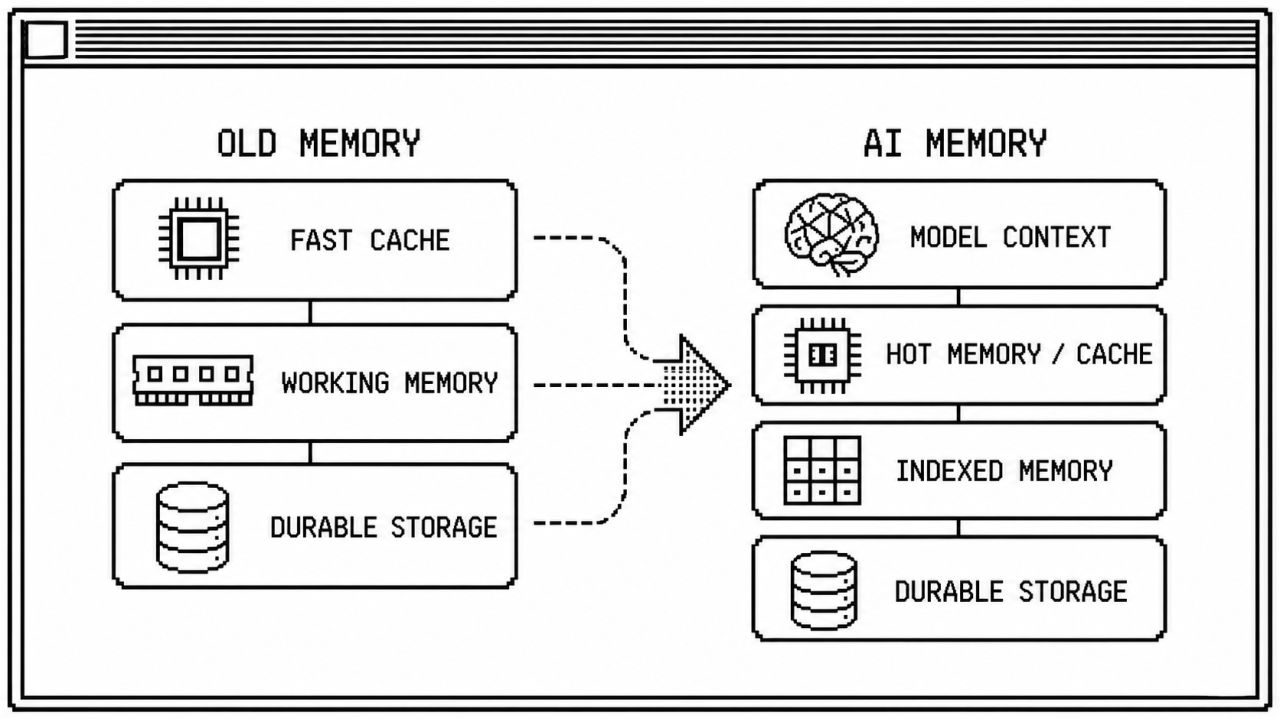
One of the most valuable capabilities of modern AI is the expanding context window.
A large context window lets a model hold much more material in mind at once: a codebase, a litigation record, a long research corpus, months of agent activity, or a substantial portion of a person’s intellectual history. There is real value in this. When the model can simultaneously see more relevant evidence, it can make connections that retrieval systems may miss.
But there is a familiar problem hiding inside that progress.
Computers once faced a similar constraint: programs were limited by how much physical RAM happened to be installed in a machine. The solution was not to keep making every byte of storage as expensive and fast as RAM. Instead, computer systems developed a hierarchy.
Disk held the large durable state.
RAM held the active working set.
Caches held the hottest material.
Virtual memory made that hierarchy appear to software as a much larger logical memory space.
AI may be heading toward an analogous architecture.
A model’s context window is extraordinarily valuable, but it is expensive working memory. Long-lived AI systems increasingly accumulate far more potentially useful information than should remain active during every inference.
The emerging question is therefore not simply:
How large can the context window become?
It is:
How large can the AI’s effective memory become while keeping only the right material in active context?
Toward AI virtual memory
A useful design principle is:
Persistent AI memory should operate as a user-owned, model-independent virtual-memory hierarchy, where semantic and deterministic retrieval control what moves from durable storage into expensive model context, while preserving an evidentiary record of the sources, retrieval, and observable AI decision process.
The analogy is not exact. AI memory cannot simply page arbitrary bytes in and out of transformer attention the way an operating system pages memory.
But the direction is increasingly recognizable.
Modern inference engines already move KV-cache state between accelerators and CPU memory when fast device memory becomes scarce. Research systems are experimenting with NVMe-backed KV caches, persistent agent states, CXL-attached memory and multi-tier context infrastructure.
The likely end state is not “NVMe instead of context.”
It is a hierarchy:
durable storage → indexed memory → hot RAM/cache → selected model context → active reasoning.
The model experiences a relatively small working set even though the larger logical memory may span years of activity.
Why context windows still matter
This is not an argument against large context windows.
Quite the opposite.
A large context window is valuable because retrieval is imperfect. Sometimes a model genuinely benefits from seeing a broad body of evidence simultaneously. A legal team might want a model to compare hundreds of related documents. A programmer might want a substantial codebase active at once. A researcher may want multiple competing papers available together.
The opportunity is to make those windows fully available when they are useful without requiring the entire historical corpus to occupy them all the time.
Virtual memory did not make RAM unnecessary.
It made RAM more useful.
AI virtual memory could do the same for context.
Personal memory
At the personal level, the application is relatively forgiving.
Imagine decades of email, AI conversations, documents, project notes and ideas living in a persistent indexed archive.
A semantic system can act as an intellectual archaeologist:
When did I first have this idea?
What earlier projects resemble it?
Which themes recur across my work?
How has my thinking changed?
Who have I discussed this with?
For this kind of exploration, products such as notebook-style semantic systems may already be surprisingly capable.
Their job is primarily to help us remember and rediscover.
Professional memory
Professional environments raise the stakes.
A lawyer does not only want a plausible relevant email. The lawyer may need every email matching a condition.
A corporation investigating the origin of an invention may need an exact timeline of drafts, discussions, contributors and prior art.
A research organization may need to reconstruct which evidence supported a conclusion at a particular point in time.
A compliance team may need to show which policy version was in force when an automated decision occurred.
In those settings, memory becomes an evidentiary system.
Semantic retrieval remains useful, but it must coexist with exact search, chronology, entity relationships, permissions, immutable source records and deterministic database queries.
Notebook-style systems help us remember and rediscover.
A professional memory substrate must also help us prove, reconstruct and audit.
AI itself will need provenance
Agentic AI makes the problem larger.
An autonomous system may perform hundreds or thousands of inference steps for a single human objective. It may search databases, read documents, delegate to sub-agents, call tools, revise assumptions and act on intermediate conclusions.
Eventually, organizations will need more than the final answer.
They will need to know:
What evidence was available?
What evidence was actually retrieved?
Which version of each source did the system use?
What tools ran?
Which model or agent performed each step?
What assumptions were introduced?
What conclusions were reached?
Which conclusions were later superseded?
What action ultimately followed?
This should not mean preserving private hidden chain-of-thought.
It means preserving the observable evidentiary trail of machine work.
That suggests three distinct forms of provenance:
Source provenance: where the underlying evidence came from.
Retrieval provenance: what information was selected for the model and why.
Reasoning provenance: the inspectable external record of assumptions, tool outputs, intermediate artifacts, conclusions, confidence, dissent and supersession.
AI memory then becomes more than memory.
It becomes an evidentiary ledger for human and machine work.
From personal prosthetic memory to economic infrastructure
There may therefore be two related markets.
The personal version is a prosthetic memory system: inexpensive, semantic, exploratory and useful for intellectual discovery.
The professional version is an economic engine: legal discovery, corporate IP, institutional knowledge, research provenance, compliance, professional commitments and accountable autonomous agents.
The same technical hierarchy supports both.
But the value proposition changes.
For the individual, the system helps answer:
What have I known, thought or forgotten?
For the institution, it helps answer:
What happened, what evidence supports it, and can we prove it?
And for autonomous AI:
What did the system know, what did it actually use, and can we reconstruct the decision?
That is why the future of AI memory may look surprisingly familiar.
Computing learned long ago that scarce fast memory should contain the working set, not the warehouse.
AI may be about to learn the same lesson.